Thursday, 5 April 2018

The power of collaboration


Hallo Leute,

The past three months have been very exciting. Let’s start from the beginning…

The collaboration with the colleagues from COWI resulted in a paper published at the Twenty-eighth (2018) International Ocean and Polar Engineering Conference (ISOPE), which will be held in Sapporo, Japan.
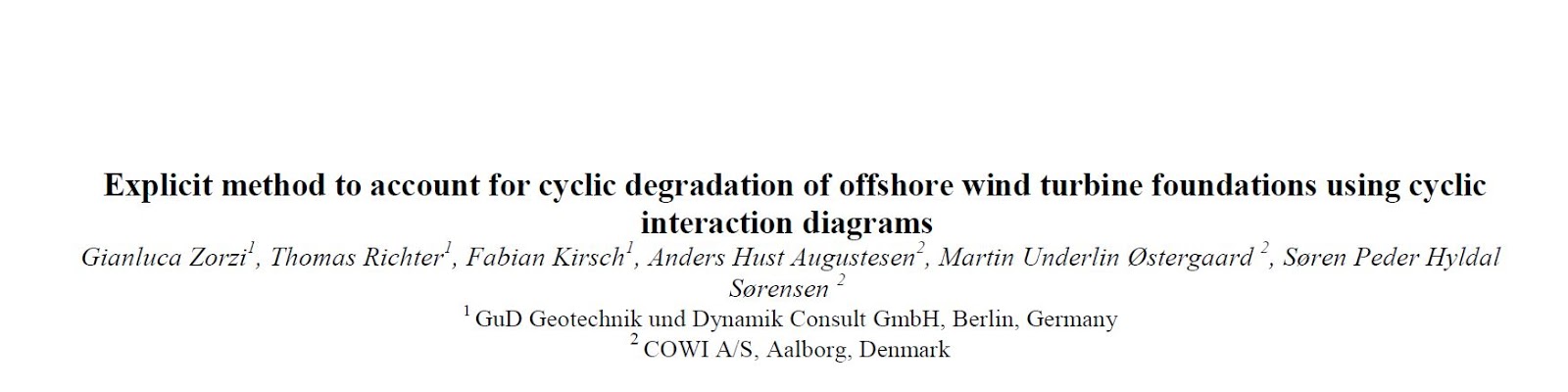
Paper submitted at the ISOPE conference
We are very satisfied with the outcome of the paper because after some months of hard work we found a new simplified methodology to evaluate the tilting of the foundations under cyclic loading. The main goal of this research is to fill the lack of the a generally accepted unified method to account for cyclic loading which is still a main challenge on the design of offshore foundations. There are quite some points now to dig deeper in order to make this method more robust and attractive. So stay tuned🔜
Poster presentation during ImpDay#1
Soon after that it was time to get ready for the Implementation Day #1 (there will be two more) which was organized jointly with BASt and the German Federal Highway Research Institute, in Bergisch Gladbach (Germany). The aim of this day was to collaborate in groups with our fellow ESR and implement practical applications, based on our knowledge developed during our own research and of course with the help of the our supervisors.
Joey (ESR8 research in COWI A/S) and I started to collaborate in early February. My topic is on offshore geotechnical engineering while his topic is on offshore structural engineering. Therefore, we found immediately something to work with and have fun.  
If we think about the design of wind turbines, we can imagine that it relies on knowledge of different engineering disciplines with multiple interfaces. An example is the soil-structure interaction for which iterative loops between the wind turbine manufacturer and the foundation designer are needed to update the load calculations at the interface level (the contact between the soil and the foundation). Therefore, in order to have a satisfactory design, a close collaboration between the geotechnical and structural engineersis necessary.
In our group project, we simulate this synergy between the two disciplines of civil engineering by studying the sensitivity of offshore gravity base foundations loads with respect to soil variability. The poster that we did is here:
Research developed with Joey (ESR8)
It was very interesting to implement this link and deal with the challenges that engineers should overcome during the design of an offshore wind turbin.

Sunday, 4 February 2018

Getting my skills up in computational geotechnics


Hallo Leute :)

Recently I participated to a 4 days training organized by PLAXIS. PLAXIS is a computer program, which is used by geotechnical engineers. It is a finite element software which can be used for different geotechnical problems such as deformation analysis, stability assessment, groundwater flow and consolidation.

The training venue was close to Schiphol airport, therefore far from the possible distraction of Amsterdam :). I was very surprised that in this training were participating so many people, we were in fourty. It was a very nice group with people from different part of Europe. The participants were from consulting and contracting companies with different background and expertise.

I chose to attend this course because it was mainly focused on the knowledge of soil behavior and advanced methods in geotechnical engineering, therefore it was more theoretical and it will reinforce my basic knowledge on soil mechanics. My research involves the use of PLAXIS therefore was also a good chance so ask some questions :)

Different lectures were held by different Professors such as, Gioacchino Viggiani (Université Joseph Fourier, UJF), Antonio Gens (Technical University of Catalonia, UPC), Prof. Steinar Nordal (Norwegian University of Science and Technology, NTNU), and different Plaxis experts such as Dennis Waterman (Plaxis bv) and Dr Paul Bonnier (Plaxis bv).

GuD Newsletter 2017

Hallo Leute :)

Every year GuD pubblishes a newsletter about what the company achived throughtout the year and interesting challenges they faced during different projects. Last year I had the honor to present our INFRASTAR project.

The language of the newsletter is German so I translated it for you :) 


GuD is a partner in the research project INFRASTAR (www.infrastar.eu), which receives € 3 million from the European Union over a period of 4 years. INFRASTAR stands for "Innovation and Networking for Fatigue and Reliability Analysis of Structures - Training for Assessment of Risk ".

The project aims to gain knowledge and experience for optimizing structural design and lifetime monitoring of cyclically and dynamically loaded structures such as bridges and wind turbines. In total, the project sponsors twelve junior scientists from different countries with the aim of achieving the PhD title in the end of the project. Gianluca Zorzi from Padua (Italy) is a PhD researcher at GuD Consult. His research is related to the lifetime prediction of offshore foundations.


How is working as a phd student in GuD?

Conducting full time research in a company is very challenging, but holds tremendous opportunities. The team of GuD helps me to focus on the essential issues and key aspects to be improved in real projects.


What is exactly your research about?

The focus of my research is to develop methods to predict the behaviour of offshore wind turbine foundations under cyclic loadings. This is still one difficult main challenge in the foundation design. At GuD we are collaborating closely with different universities such as the University of Padova and Technical University of Berlin. We also exchange ideas with others Universities and companies involved in the INFRASTAR project.


What is so fascinating about wind turbines?

Wind turbines, especially in the offshore sector, are definitely playing a major role in fighting the challenges that the climate change poses to our society. As an engineer researching on wind turbines, I am dealing with highly dynamic structures, which are not comparable in other areas of civil engineering. I hope my research can do their part to further optimize the design solutions and make them even more economically interesting.


Thursday, 2 November 2017

My first secondment


Unfortunately it is already time to leave Aalborg. It is such a lovely city where to live. You just have to get used to the weather :).


This city is a bit special because I did my Erasmus back in the days (2015). I was very happy when I discovered that one of my secondments was actually in Aalborg. I have a lot of good memories and friends and I was very happy to meet them again.
When I applied for my Erasmus I chose Aalborg because the study form is project-organised (you have hands on different realistic projects) and you are working in groups. I found it very useful because when you have to solve a problem, you can discuss it with your group mate, have different approaches and ideas to solve the task.
This group work method of Aalborg University had an influence as well on private companies. Here in COWI they adopted an open space office and the projects are solved as a team effort.
I am very happy of these two months spend here in COWI. I am very grateful to my colleagues (Anders, Martin, Soren, Aske and Karsten) which helped me a lot.
You now may ask, what have I done here? In these two months of my secondment we worked on a method for predicting the behaviour of offshore foundations under cyclic loading. This collaboration is not ending here but we will have still some monthly meetings and a lot of things to do. 

Yesterday (1.11) we had a very productive meeting between COWI and GuD. We discussed the state of the art of my work and the future developments. We sent an abstract, which was accepted, for the ISOPE2018 conference (it will be in Japan :) )
Nest stop back to Berlin...

Monday, 2 October 2017

What a September!


This month was full of new adventures! 

I started my secondment in COWI. Therefore I moved to Aalborg, Denmark. This secondment will give me the possibilities to network with the geotechnical experts in COWI in order to collaborate in a new project for my PhD thesis. 

A part of that, it is also very nice to be in a different style of working which is very interesting and is always a good experience. This part of my thesis is to create a Python-Plaxis interface to account for the evolution of soil properties under cyclic loadings. This will be very relevant in the design of offshore structures.

One of the great things about the Marie-Curie ITN PhD programs is the possibility to network and reach out other people to explain your work and spread our knowledge gained so far. I participated in the T-MAPPP workshop (Training in Multiscale Analysis of MultiPhase Particulate Processes and Systems) in Hannover. T-MAPPP is an Initial Training Network funded by FP7 Marie Curie Actions. 


I have done a poster presentation in which I explained my work developed in this first year of PhD. The workshop was about particles processes with industrial and academic contributions. The workshop was divided in some invited sessions and some discussion groups mainly focus on calibration and validation of numerical modelling of particles. I am very thankful to the TMAPPP partners to let me present my work. 
I participated in the conference Particles2017 in Hannover in which I wrote a paper (LONG-TERM CYCLIC TRIAXIAL TESTS WITH DEM  SIMULATIONS) and presented my work. It was a very good opportunity to network and meet so many researchers, professors and industries working with particles systems.

The craziest thing I did during my time as a PhD - Becoming a PhDaddy

If you ask me which was the most beautiful thing that happened to me during my PhD, I will most definitely reply: Becoming a father!   J...